
• Skip to primary navigation
  • Skip to main content
Texas and Southwestern Cattle Raisers Association

Texas and Southwestern Cattle Raisers Association

To Honor and Protect the Ranching Way of Life

  • Home
  • Who We Are
    • Why Join
    • Leadership
    • Staff
    • Partners
    • FAQs
    • Newsroom
    • Sponsorships & Advertisement
    • Employment
  • What We Do
    • Theft and Law
    • Issues & Policy
    • Education
    • Students and Young Professionals
    • The Cattleman Magazine
    • Disaster Relief Fund
    • Cattle Raisers Insurance
    • Cattle Raisers Trading Co
  • Events
    • Cattle Raisers Convention
    • Policy Conference
    • Summer Meeting
    • Ranch Gatherings
    • Ranching 101
  • Join
  • Member Center
  • TSCRA Store
  • Show Search
Hide Search

ForageFax: Native grasses for Texas

Source: Texas A&M AgriLife Extension | April 5, 2019

You may be surprised to learn that bermudagrass and bahiagrass are NOT native to Texas, much less to the United States. There are numerous species of grasses and forbs that can be utilized for forage throughout the state of Texas. Keep in mind as you select forages to be mindful of your production system goals, location (soil type and rainfall), and the nutrient needs of our livestock and/or wildlife.
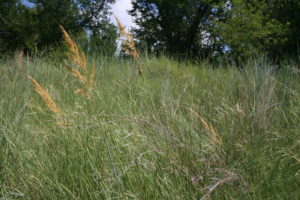
Indiangrass and Little bluestem. Photo courtesy of Jack LeClair

Many livestock producers are considering forage species and varieties that do not require as much fertilizer as bermudagrass.

At the same time, many landowners have expressed interest in restoring native prairies for wildlife habitat enhancement. Native grasses are well adapted and quite persistent with good grazing management, but typically are not used for hay production.

vNatives grasses may require longer time to establish and are less tolerant of overstocking. If interested, check with your local county extension agent, Natural Resources Conservation Service (NRCS) personnel, or Texas Parks and Wildlife biologist to determine which species are best adapted to your location.

Some native grass species:

  • Little bluestem
  • Indiangrass
  • Eastern gamagrass
  • Switchgrass
  • Sideoats grama
  • Big bluestem

Some native forb species:

  • Maximillian sunflower
  • Engelmann daisy
  • Illinois bundleflower
  • Bush sunflower

Dr. Megan Clayton, associate professor and Extension range specialist, has some excellent resources that can help guide the decision making process on the utilization of native forages. Click here to download a 7-page PDF “Using Goals and Profitability to Determine What to Plant in Pastures.”Deciding What to Plant

by Vanessa Corriher-Olson
Forage Extension Specialist, Soil & Crop Sciences, Overton
Texas A&M AgriLife Extension Service
Texas A&M University System

Written by:
kristin
Published on:
April 8, 2019

Categories: Feed & Forage, Natural Resources, Plants, Ranching, The Cattleman Now, The Cattleman Now - App

Recent Posts

Cattle Raisers Convention & Expo to increase registration prices Feb. 20 

February 18, 2026

FORT WORTH, Texas (February 18, 2026) — Early-bird registration pricing and official hotel …

Continue Reading about Cattle Raisers Convention & Expo to increase registration prices Feb. 20 

Crime watch: Cattle missing in Wise County

February 17, 2026

Cliff Swofford, in North Texas, reports four black cows missing from a property off FM 1810 at Big …

Continue Reading about Crime watch: Cattle missing in Wise County

Crime watch: Horned Hereford bull missing in Fannin County

February 17, 2026

Texas & Southwestern Cattle Raisers Association Special Ranger Randolph McGee, District 11 in …

Continue Reading about Crime watch: Horned Hereford bull missing in Fannin County

Footer

Texas and Southwestern Cattle Raisers Association
  • Email
  • Facebook
  • Instagram
  • Twitter
  • YouTube

PO BOX 101988
FORT WORTH, TX 76185

1-800-242-7820

© 2023 Texas & Southwestern Cattle Raisers Association; All Rights Reserved.

COPYRIGHT | PRIVACY POLICY | TERMS OF USE