
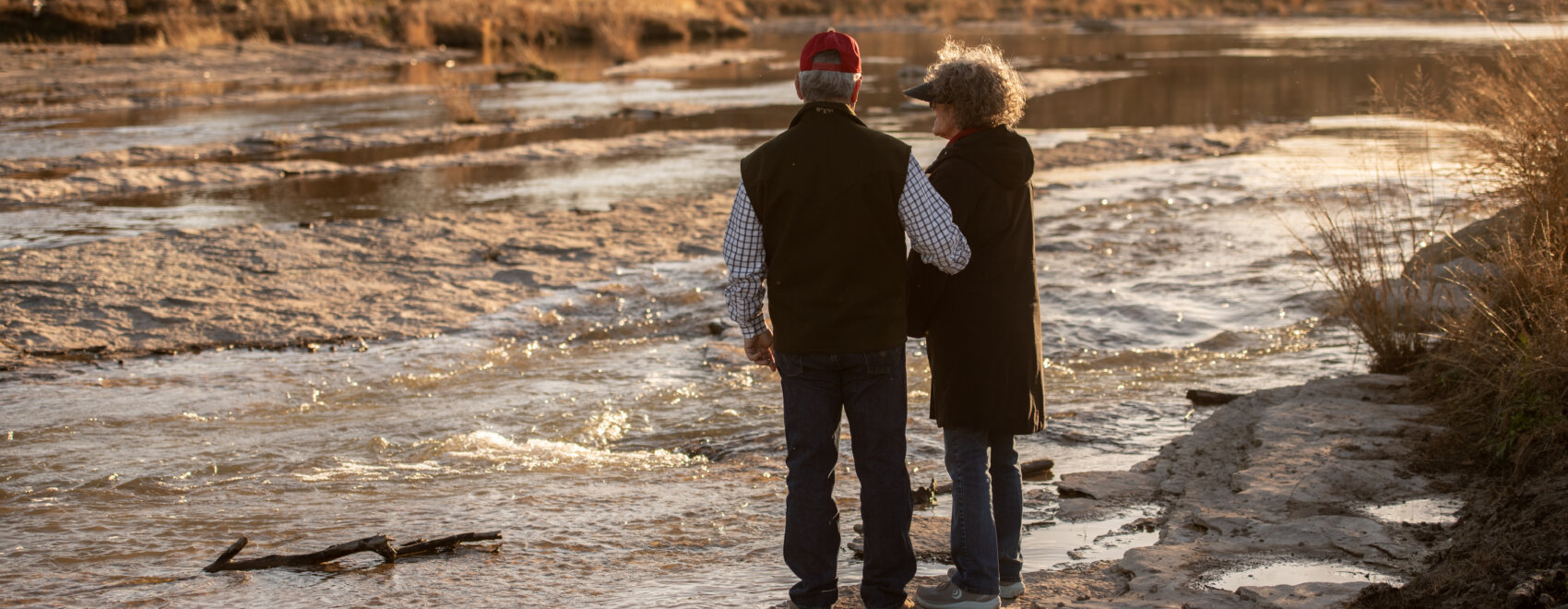
A proposed transmission line near the San Saba River has landowners questioning impacts.
Story by Diane Meyer
Photos by Kayla Jennings
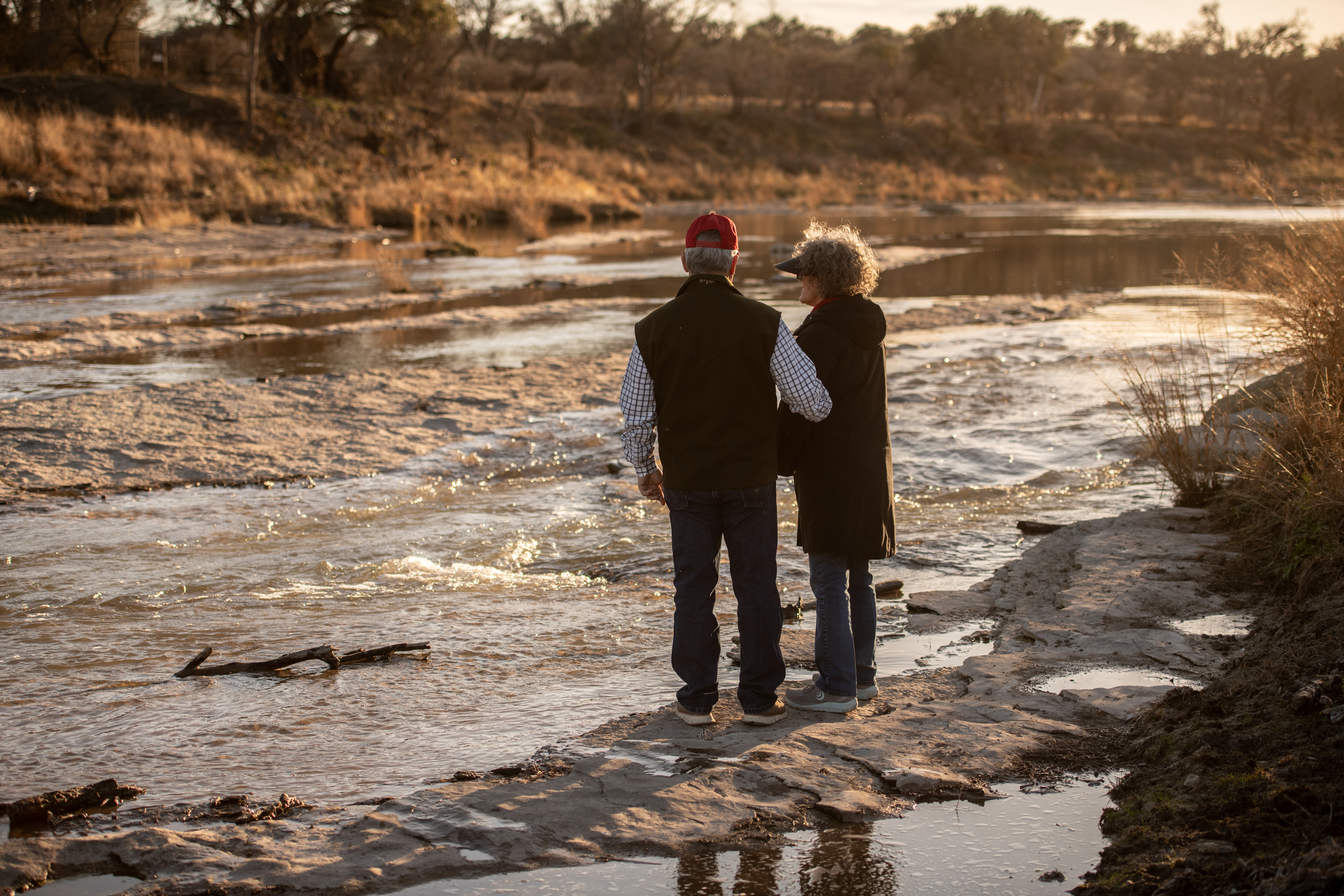
Gerald Nobles Jr. never expected his health would force him to leave the land his family had worked for generations.
When severe allergy attacks sent him to the world’s leading respiratory hospital, doctors at National Jewish Health in Denver told him he could no longer live on his West Texas ranch. He and his wife, Debbie, made the difficult decision to relocate their cattle and horse operation in search of cleaner air and a healthier future.
They found it in the heart of Texas, along the San Saba River.
“We said, if we’re going to go to the Hill Country, it would sure be nice to have water. We have an ocean of water underneath us — at least I call it an ocean,” Gerald says. “It’s a dream come true for both of us. We love it here.”
A fifth-generation rancher on both sides of his family and a Texas & Southwestern Cattle Raisers Association director and former executive committee member, Gerald knew this scenic haven along the river was a new foundation for their operation, livestock and quality of life.
That foundation, however, was in danger. When the Nobles family moved in 2011, Texas was in the grip of an extreme drought. “The river was mostly nothing at that time,” Debbie recalls. “There wasn’t much water flow at all.”
The following year, to combat growing threats to the river’s long-term health, the couple joined Friends of the San Saba River, known as FOSS. The landowner-led group was working to address illegal wells drawing water from the river, among other harmful activities.
After years of hard work, their efforts provided new protections to stabilize waterflow. “It’s much better now,” Debbie says. “This is what we work for.”
In June 2025, another threat emerged — one they say could undo that progress.
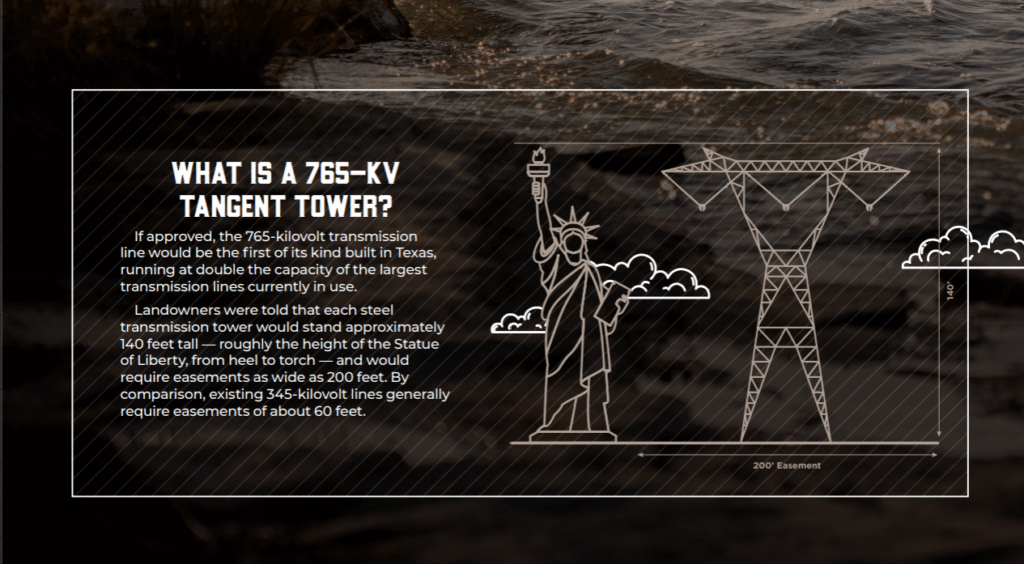
A shocked Gerald and Debbie received a letter from Oncor Electric Delivery Company and the Lower Colorado River Authority, or LCRA, announcing plans for a proposed 765-kilovolt transmission line — the highest-voltage power line currently used in the U.S. — potentially routed through Central Texas, crossing the San Saba River in multiple locations. The transmission line, intended to deliver electricity from Central Texas to the Permian Basin, would be the first of its kind built in the Lone Star State.
A whirlwind of concerns followed: impacts to wildlife habitat, water quality, erosion and flooding, disruption to livestock operations, loss of property value and the use of eminent domain.
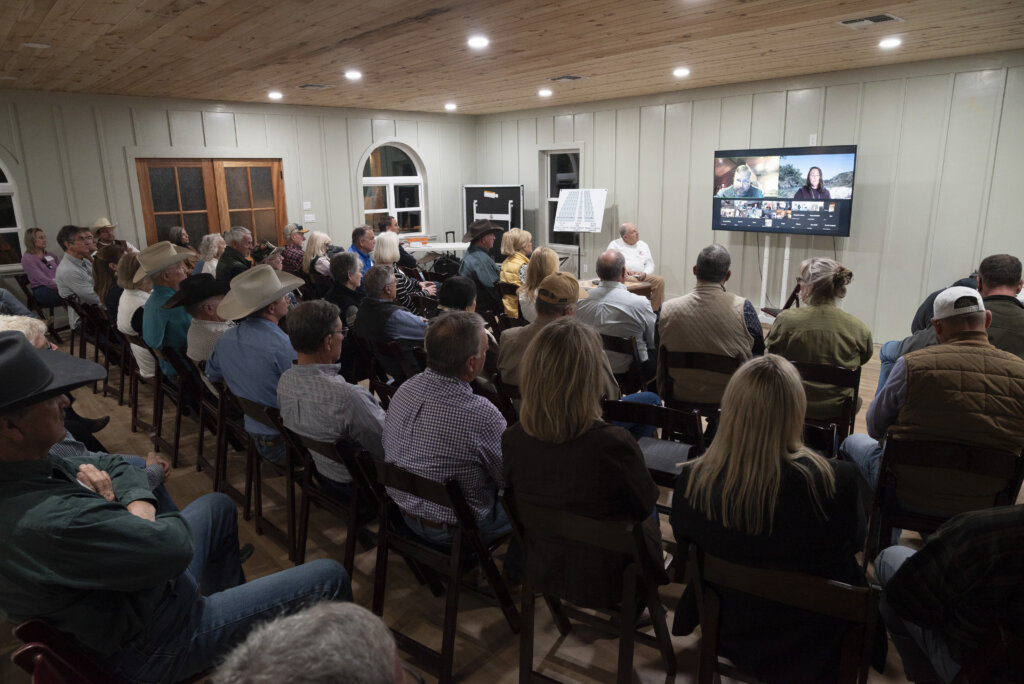
Hoping to learn more, Gerald and Debbie attended a public town hall meeting in Menard, as directed in the letter. What they heard there, Gerald says, left them stunned and convinced that landowners along the San Saba River needed to act.
Nuts and bolts
The proposed 765-kV transmission line is part of a broader effort to meet rapidly growing electricity demand in West Texas.
The project traces back to House Bill 5066, passed by the state legislature in 2023, which directed the Public Utility Commission of Texas to require the Electric Reliability Council of Texas, or ERCOT, to develop a long-term plan for high-growth regions of the state. ERCOT works with transmission and distribution providers such as Oncor and LCRA to identify and develop infrastructure projects to meet future demand.
The primary driver of this need is the Permian Basin, Gerald says, where expanding oil and gas operations increasingly rely on electricity to power modern drilling technologies. Additional energy demand is also expected from proposed bitcoin mining and artificial intelligence data centers.
The segment of the proposed line drawing concern from landowners along the San Saba River is known as the Bell County East to Big Hill project. It would run from a substation near Temple to the Big Hill substation in northwest Schleicher County. According to information presented at last June’s public meeting in Menard, utility companies are considering three potential routes — or a combination of those routes — for the line. In all scenarios, the transmission line would cross the San Saba River.
At that first landowner meeting, Gerald and Debbie learned one of the proposed routes would cut directly through the middle of their property. “It was very sobering,” he says.
The meeting raised significant concerns for Gerald and many others. He recalls how the maps shown lacked basic reference points, including major roadways and waterways, making it difficult to understand the project’s full scope. Oncor and LCRA company representatives were unable to answer questions about potential environmental impacts, effects on property values or how the routes had been selected.
“There was no thought about the impact on the people or the community at all,” Gerald says. “It’s build, build, build, and we’ll solve the problems later. Well, that’s no way to do it.”
Landowners organize
Among the group of concerned landowners was Dave Clark, a retired certified public accountant whose family has owned ranchland along the San Saba River in McCulloch County since the 1870s.
After Debbie contacted him about the proposed transmission line, Clark and other FOSS leaders quickly recognized the need for a coordinated response. The group called a meeting that drew 84 landowners, many of whom shared similar concerns about water, wildlife, property values and long-term land use.
FOSS made a deliberate decision to oppose all three route options and advocate for moving the line entirely out of the river corridor. Members proposed placing the line along existing rights-of-way or easements, such as the planned I-14 corridor, rather than near the river and its tributaries.
The advocacy group, which grew from fewer than 50 members to nearly 200 after the proposed line was announced, sought guidance from Austin-based legislative consultants on landowner rights, transmission line siting and the 2023 long-term reliability legislation.
In a conversation with LCRA, Gerald was frustrated to learn how the routes were mapped. “They drew a straight line from point A to point B, and those were the three routes that resulted from a fly-over,” he describes. “[They] had no knowledge of the area or the Hill Country, or property values.”
Clark agrees the routing process failed to adequately weigh the consequences of this untested infrastructure in Texas. “Our view is these 765-kV transmission lines will destroy the habitat, impact wildlife and livestock, and increase flood risk in places where the lines cross or run close to the San Saba River,” he says.
Flooding is one of the most immediate dangers. Clearing the 200-foot easement of trees, brush and other vegetation would raise the floodplain and increase erosion, exacerbating problems in a region already prone to flash flooding.
In 2025 alone, the San Saba River flooded three times — most notably during July’s historic flood that resulted in the sixth-deadliest freshwater disaster in the U.S.
As demonstrated by those floods, emergency access and recovery during natural disasters can be extremely challenging, and adding towers of this size in such a volatile, flood-prone corridor only heightens public safety risks and threatens electric grid reliability.
Wildlife in the river corridor also face significant risk, including white-tailed deer, turkey, quail and other species relying on the river and surrounding habitat for water, food and cover. Displacing those animals could disrupt local ecosystems, reduce game populations and negatively affect hunting-related revenue for nearby communities, while utility activity along easements during hunting season could cause further disruptions.
Additionally, four species of endangered freshwater mussels inhabit the San Saba River. Under the June 2024 endangered species listing and a 2023 Candidate Conservation Agreement with Assurances, LCRA is required to consult with the U.S. Fish and Wildlife Service on projects that could affect endangered species.
As of press, Clark says LCRA has not consulted with the U.S. Fish and Wildlife Service. Notices to landowners, public meeting materials and filings with the Public Utilities Commission have not disclosed that all proposed routes pass through a federally and state-designated Conservation Zone.
Beyond environmental concerns, landowners worry about lower property values and resulting decreased tax revenue for cities and counties.
“They’re destroying the tax base of the highest-valued land in the Hill Country,” Gerald says. “The money [we’re] going to get out of eminent domain is not going to come close to covering the devaluation of the actual land.”
Building transmission lines across higher-valued land increases the project’s overall costs, which utility companies can recover through electricity rates, meaning all Texas ratepayers will bear the expense of selecting more expensive routes.
Ultimately, Clark says, “It totally ignores the sensitivity of the Central Texas Hill Country’s landscape and rivers. The 140-foot-tall towers are going to be taller than anything that exists in any of these counties. The Hill Country is never going to be the same.”
Ongoing efforts
Since learning about the proposed transmission line, FOSS has focused on convincing involved parties that Oncor and LCRA should select routes away from the flood-prone river and sensitive habitats.
Clark and Gerald point to existing easements along U.S. highways 190 and 87 that can accommodate the transmission lines without disrupting the river. Not only would construction be easier on flatter terrain, but land values along those routes are 30 to 50% lower, potentially reducing costs for the utility companies. Moving the line to these existing rights-of-way, however, would require notifying new landowners and engaging them in the same public processes already conducted with the original proposed routes.
Clark says precedent supports the group’s efforts to move the line to an existing route. Previously in Mason and Gillespie counties, a 345-kV line was rerouted away from scenic waterways and landscapes to an existing right-of-way along I-10. Clark sees this as a model for how the Bell County East to Big Hill line could be sited more responsibly.
FOSS has also received support from state legislators and agencies that agree the line should follow existing rights-of-way or easements away from the river whenever possible.
The group is carefully monitoring the timing of the Public Utility Commission application, now expected in March or April instead of the original December 2025 deadline. While other segments of the broader 765-kV transmission line project have already advanced to the application stage, Clark says the delay on this particular line reflects the level of concern surrounding its proposed route, and FOSS remains hopeful the utility companies will restart the process and pursue an alternative outside the San Saba River corridor.
For the Nobles family, the fight against the transmission line is personal as well as practical.
“We want to take care of the river,” Gerald explains. “We understand the importance of water, and we want to preserve the water that belongs to all Texans.”
Having realized their dream in the Hill Country, the couple is acutely aware of what’s at stake.
“We’re in our mid-70s now, and we want to enjoy it,” Gerald says. “And it breaks our hearts to know that this [transmission line] could come through here.”
With two sons and three grandchildren, the couple hopes to preserve the ranch for future generations. One son manages the ranch on the San Saba and a second ranch about 40 miles away. Passing along their property in the best condition is a top priority.
“This isn’t something we do simply because it’s all we know. We do it because we love it,” Gerald says. “And I have paid attention to heritage my whole life.”
For now, the Nobles’ focus remains on stewardship of the land and river, and ensuring future Texans can enjoy this state treasure.
“We’ve been blessed and we’ve really worked toward a goal, and God has given us that goal,” Gerald says. “And now to think that it may be destroyed is truly sad.”
—-
Diane Meyer is the associate director of content for Grant Company based in St. Joseph, Missouri.
—-