
Source: Texas A&M Forest Service
Oak wilt is one of the most destructive tree diseases in the United States, killing millions of trees in 76 counties of Central, North and West Texas. Texas A&M Forest Service urges Texans to help stop the spread of oak wilt by avoiding pruning or wounding oak trees from February through June.
“This native fungus has been affecting oaks for decades in Texas; prevention and early detection are vital to stop the spread,” said Texas A&M Forest Service regional forest health coordinator Demian Gomez.
Oak wilt spreads easiest in the spring because of high fungal mat production, high insect populations and the high susceptibility to disease for oaks. In the spring, red oaks that died of the disease last summer and fall may produce spore mats under the bark. With a fruity smell, these mats attract small, sap-feeding beetles that can later fly to a fresh wound of any oak tree and infect it, starting a new oak wilt center.
Any new wound can be an entry point for infection including those produced by pruning, construction activities, livestock, land or cedar clearing, lawnmowers, string trimmers and storms. To decrease the attractiveness of fresh wounds to insects, always paint wounds on oaks, no matter the time of the year.
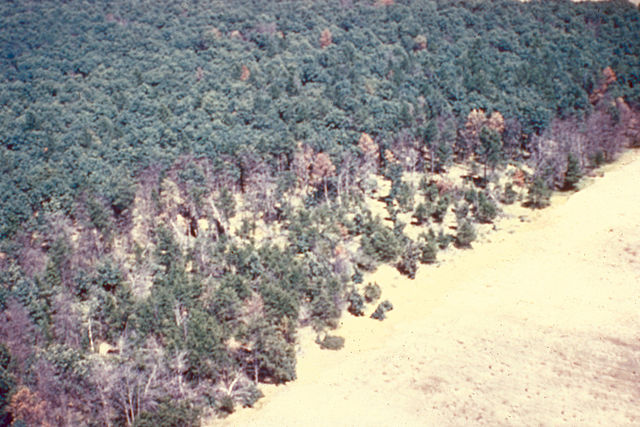
Oak wilt is often detected by yellow to brown veins in leaves of infected live oak trees. During the spring, evergreen oak trees will shed their old leaves, while simultaneously growing new leaves. Oak wilt foliar symptoms are different from this seasonal transition in that they affect every leaf. For red oaks, pale young green or brown leaves can be observed during the spring in infected trees.
All oaks are susceptible to oak wilt disease. However, red oaks are most susceptible and can die in as little as one month after being infected. Live oaks show intermediate susceptibility but because of their interconnected root systems, they can move the disease easily. White oaks are the least susceptible, but they are not immune to infection.
While red oaks play a key role in the establishment of new disease centers, live oaks and white oaks can also move the oak wilt through root grafts. Prevention is key, but early detection is crucial to limiting the spread of oak wilt.
It is critical to avoid pruning oaks at this time of year to prevent the spread of oak wilt, and should only be considered if there are immediate safety concerns.
The recent winter storm caused significant ice damage across Texas, and oak trees were not an exception.
“Wounds created by the ice storm are no longer fresh and do not need to be painted; however, any new wounds created during cleanup must be painted immediately,” said Texas A&M Forest Service Biologist, Robert Edmonson.
For more information on ice damage and oak wilt, click on the following: Ice Damage and Oak Wilt.
Some cities and municipalities, including Austin, the City of Lakeway, Dallas, Fort Worth, Houston and Round Rock, have oak wilt programs in place with municipal foresters dedicated to managing the disease. Texans can also contact their local Texas A&M Forest Service representative with any questions about this devastating disease.
For more information on oak wilt identification and management, visit https://texasoakwilt.org/ or Texas A&M Forest Service’s website at https://tfsweb.tamu.edu/.