
• Skip to primary navigation
  • Skip to main content
Texas and Southwestern Cattle Raisers Association

Texas and Southwestern Cattle Raisers Association

To Honor and Protect the Ranching Way of Life

  • Home
  • Who We Are
    • Why Join
    • Leadership
    • Staff
    • Partners
    • FAQs
    • Newsroom
    • Sponsorships & Advertisement
    • Employment
  • What We Do
    • Theft and Law
    • Issues & Policy
    • Education
    • Students and Young Professionals
    • The Cattleman Magazine
    • Disaster Relief Fund
    • Cattle Raisers Insurance
    • Cattle Raisers Trading Co
  • Events
    • Cattle Raisers Convention
    • Policy Conference
    • Ranch Gatherings
    • Summer Meeting
    • Ranching 101
  • Join
  • Member Center
  • TSCRA Store
  • Show Search
Hide Search

ForageFax Weed of the Week: Yellow false indigo

Source: Texas A&M AgriLife Extension | March 15, 2019

by Vanessa Corriher-Olson, associate professor and forage extension specialist, Soil & Crop Sciences, Texas A&M AgriLife Extension, Overton
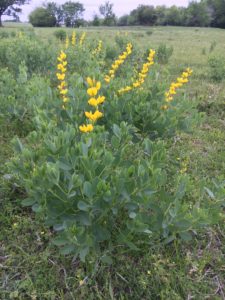
Blooming Yellow False Indigo. Photo Courtesy of Mr. Kip Stansell

Blooming Yellow False Indigo. Photo Courtesy of Mr. Kip Stansell.

Yellow False Indigo (Baptisia sphaerocarpa) have a very wide, natural range to which they seem well adapted. It is native to the lower Midwest and Gulf states.

As a group, these perennials are deer resistant, heat and humidity tolerant and drought tolerant.

Height and width vary by species. It grow up to 2 to 3 feet tall by 2 to 4 feet wide with upright stems. Flower spikes are 12 to 15 inches long with large, bright yellow flowers held above bright green foliage.

Most indigo species bloom in March, April or early May, but it varies depending on species, region and weather. Bloom typically lasts between 3 and 6 weeks. Leaves are trifoliate (composed of three leaflets) and are arranged alternately along the stems. Leaflet shapes vary from slender oblong to almost rounded oval. Leaves vary in color from blue-green to bright yellow-green to soft, felted gray-green. Leaves turn black rapidly in summer/fall.

Plants prefer rich, deep and well-drained soil, but tolerate poor, sandy soil as well.
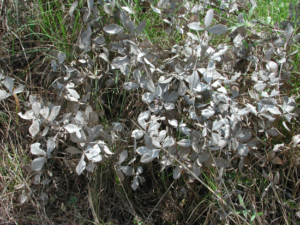

Yellow False Indigo with Blackened Leaves

Select Herbicide Options:
Grazon P+D
Tordon 22K
RemedyUltra
Pasturegard HL
Surmount

REMEMBER: THE LABEL IS THE LAW! Always read the pesticide label before using.

ForageFax is by the Texas A&M AgriLife Extension Department of Soil & Crop Science, offering timely forage and pasture information.

Written by:
kristin
Published on:
March 18, 2019

Categories: Feed & Forage, Natural Resources, Plants, The Cattleman Now, The Cattleman Now - App

Recent Posts

Crime watch: Angus bull missing in Comanche County

April 2, 2026

Texas & Southwestern Cattle Raisers Association Special Ranger Zach Havens, District 9 in …

Continue Reading about Crime watch: Angus bull missing in Comanche County

Crime watch: Black bull missing in Washington County

April 2, 2026

Texas & Southwestern Cattle Raisers Association Special Ranger Brent Mast, District 22 in East …

Continue Reading about Crime watch: Black bull missing in Washington County

Caldwell County district attorney receives top prosecutor award

April 1, 2026

Fred Weber recognized for commitment to prosecuting livestock theft cases FORT WORTH, Texas …

Continue Reading about Caldwell County district attorney receives top prosecutor award

Footer

Texas and Southwestern Cattle Raisers Association
  • Email
  • Facebook
  • Instagram
  • Twitter
  • YouTube

PO BOX 101988
FORT WORTH, TX 76185

1-800-242-7820

© 2023 Texas & Southwestern Cattle Raisers Association; All Rights Reserved.

COPYRIGHT | PRIVACY POLICY | TERMS OF USE