
From ForageFax, information by the Texas A&M Extension Department of Soil & Crop Sciences
As forage producers, we focus most of our energy on our warm season perennial pastures and hay meadows (bermudagrass, bahiagrass, etc.). That means most of our weed control efforts are also focused on warm season weeds (such as carolina horsenettle, blackberry, etc). Unfortunately, cool season weeds can be just as detrimental to our warm season perennial forages.
Annual ryegrass…a cool season annual forage often utilized by livestock producers for winter grazing. However, it’s often deemed an enemy of many a hay producer in East Texas. Later maturity of annual ryegrass can delay or prevent our warm season perennial forages from breaking dormancy in April/May therefore delaying our initial hay cutting. There are multiple ways to manage unwanted ryegrass (see ForageFax article for more details). Use of herbicides to control annual ryegrass is probably the most common method practiced. Pendimethalin can be used as a pre-emergent herbicide for dormant bermudagrass and bahiagrass pastures and hay meadows. Glyphosate; metsulfuron and nicosulfuron are post emergent herbicide options.
Henbit is a plant that is not generally considered a pasture weed. It can become a major competitor with bermudagrass in the early spring for moisture and nutrients. 2,4-D alone is not highly effective against henbit. However, glyhphosate in the dormant season; mixtures of 2,4-D and glyphosate; and mixtures of 2,4-D and dicamba, picloram, aminopyralid, and metsulfuron; are quite effective against henbit. Henbit is a cool season annual and should be sprayed when it is small for best results.
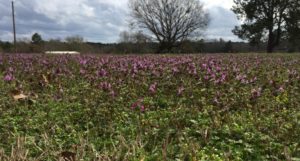
Henbit
If left uncontrolled, thick thistle stands can reduce grazing and result in less forage production. Best time to control with a herbicide is when thistles are in the rosette stage. The rosette stage is when the thistle forms a low-growing ring of leaves (November – March). If thistles have bolted or developed seed heads, they are much more difficult to control. Several broadleaf herbicides are effective against thistles if they are in the rosette stage (2,4-D alone; 2,4-D with picloram; dicamba or aminopyralid; metsulfuron methyl; or a combination of metsulfuron methyl with 2,4-D and dicamba).

Thistle in rosette stage
Texas Groundsel or Texas squaw-weed is another common cool season annual weed. Control is less expensive and more likely if plants are treated while still in the rosette stage. Once the plant begins to bolt, more herbicide is required. 2,4-D alone can be effective if applied in the rosette stage. Other effective products include: 2,4-D and dicamba, 2,4-D and aminopyralid, aminopyralid, metsulfuron, metsulfuron and nicosulfuron, metsulfuron with 2,4-D and dicamba. For more details on Texas groundsel see ForageFax article.
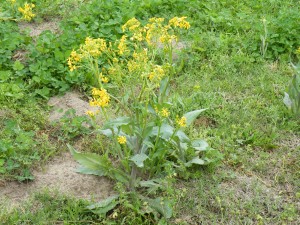
Mature Texas Groundsel
Winter weeds are not a problem in all perennial warm-season pastures and hay meadows. Fields should be scouted to determine if treatment is warranted. In most cases, controlling winter weeds in summer perennial pastures involved an additional application since it is unlikely that an application during the dormant season will control summer weeds.
Strict adherence to label directions is required by law. Paying close attention to label directions will also ensure safe, effective and economical use. Herbicide labels contain directions for proper rate and timing of application, a list of susceptible species, and information regarding cleanup and disposal following use.
Vanessa Corriher-Olson, Ph.D.
Associate Professor, Forage Extension Specialist, Texas A&M AgriLife Extension
Soil & Crop Sciences Department, Overton, Texas
903-834-619
[email protected]