
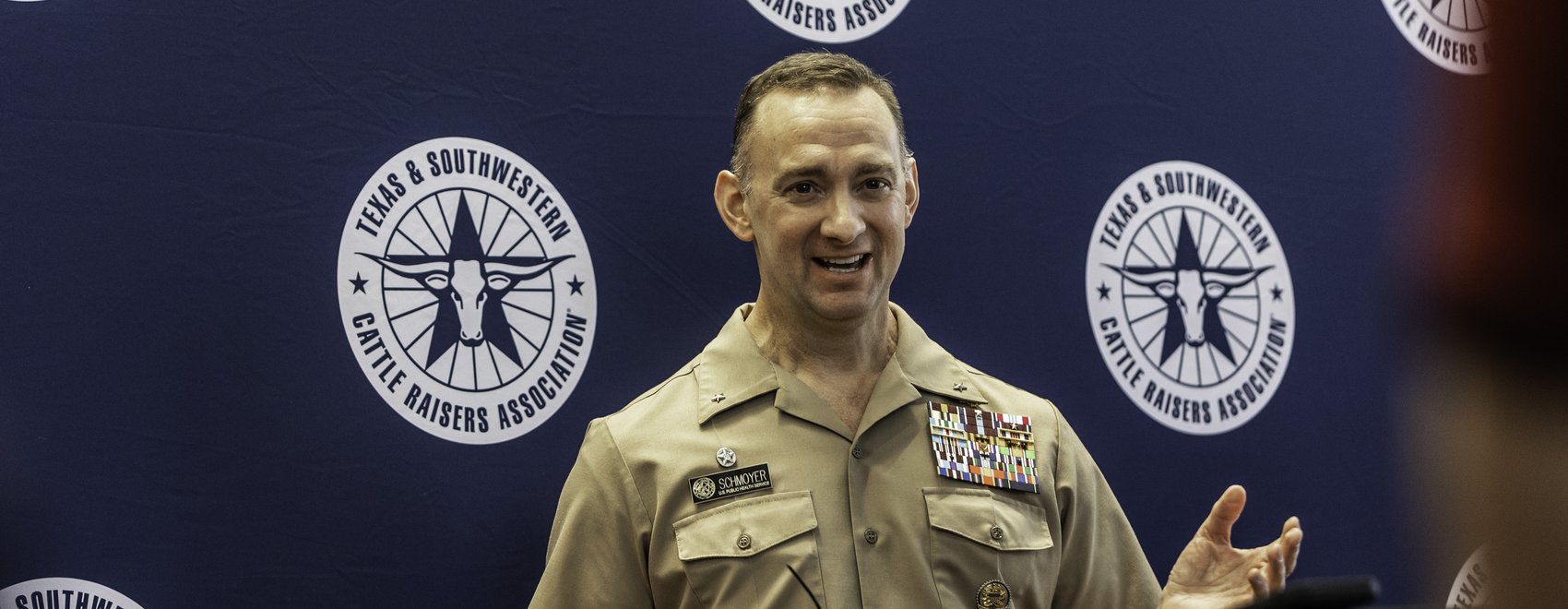
Michael Schmoyer leads the synchronized effort to contain New World screwworm.
By Diane Meyer
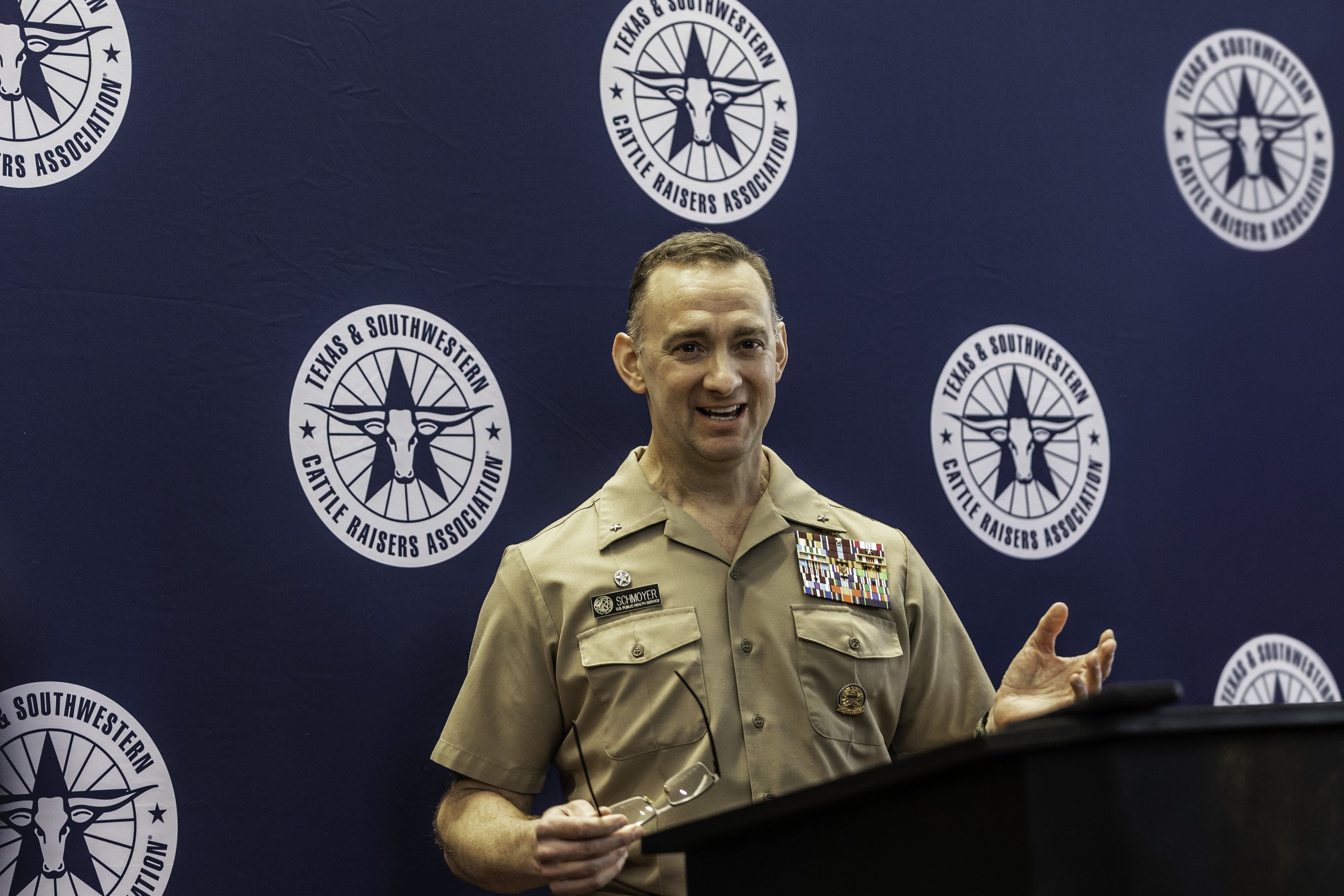
Rear Adm. Michael Schmoyer strode off the jet bridge at George Bush Intercontinental Airport in Houston, preparing to head to the terminal for his flight to Panama. Traveling from his home in Washington, D.C., he was dressed for summer in Central America, not in his usual service uniform.
His phone began to buzz, and he sensed it was something urgent. “Don’t go to Panama,” a representative from the Secretary of Agriculture’s office instructed when he answered. “We need you to stay there.”
It was June 3, and the first case of New World screwworm had just been reported. In an instant, Schmoyer’s three-day visit to the COPEG sterile fly facility turned into an indefinite stay in Texas.
Within hours, he was in Austin at the Texas Animal Health Commission headquarters, still wearing his “jungle clothes.” The next morning, he briefed the governor and gave a press conference.
In the weeks following, he traveled far and wide across Texas, speaking in more than 45 town hall meetings to thousands of producers. The rapid shift and immediate action in Schmoyer’s itinerary reflect a response effort that had been thoughtfully coordinated long beforehand.
A synchronized response
Since the first case was confirmed, resources across the state and federal governments have been deployed to contain the spread. The federal government’s response to NWS is the first of its kind for an animal health emergency because the effort reaches far beyond USDA, incorporating other federal departments as well as state agencies, universities and producer resources.
That approach is rooted in Schmoyer’s background responding to biological threats. During more than two decades in uniform, his work has included the Ebola response from 2014-2015 and H1N1/H5N1 efforts with Mexico in 2009-2010. Schmoyer previously worked for the CDC in Central America, where he first learned about NWS.
The rear admiral’s distinguished career in biological defense aligned with the strategy U.S. Secretary of Agriculture Brooke Rollins wanted to build, and her office approached him to head NWS efforts in July 2025. A month later, he joined USDA as an associate administrator in the Animal Plant Health and Inspection Service.
“When I joined, Secretary Rollins asked, ‘What is it that we need to do to make this effective?’ And I said, ‘We really need to make sure that we have a unifying presence as far as the overall federal government.’”
Two weeks after he was hired, the NWS Directorate was created, with Schmoyer at the helm.
In October 2025, the National Security Council designated USDA as the lead federal agency for NWS coordination across more than 240 federal government departments and agencies. It collaborates with traditional partners such as the EPA, FDA and CDC, and can also tap nontraditional animal-health partners including the Department of Homeland Security, Department of War, and Department of Health and Human Services.
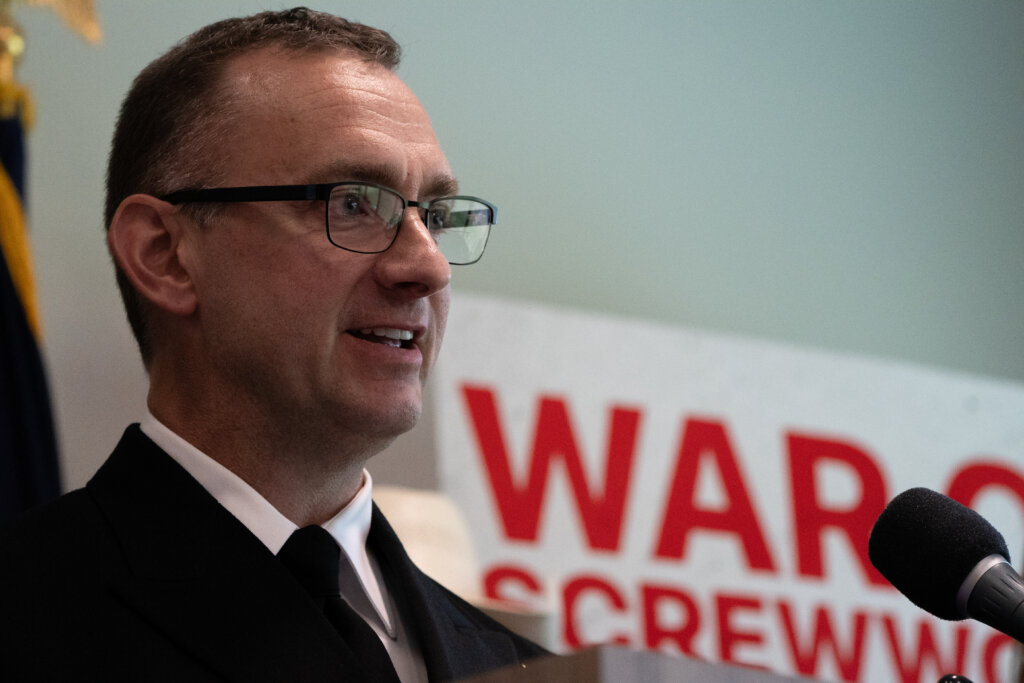
From there, federal resources connect with state agencies, universities, producer organizations and other local partners. Schmoyer says this synchronizing body is not common for the federal government, especially for animal health issues.
“This makes it so much more streamlined for our partners in Texas, our cattlemen, our producer groups and state partners,” he says. “We track all of the different resources and capabilities that the federal government has to bring to bear.”
For example, the USDA can use DHS technology like border surveillance and drones that it otherwise wouldn’t have access to. Additionally, the construction timelines for Texas’ Moore Air Base were expedited from five years to less than one year using the Department of War’s emergency authorities.
The value of that streamlined structure has been reflected in the response since the first confirmed domestic case. As of Sept. 3, the U.S. had 48 confirmed NWS cases, 47 of which were in Texas, and only 3 of which were listed as active. For comparison, 90,980 domestic cases were recorded in 1972.
Now, when a case is reported, laboratory diagnostics can be completed and response teams deployed within 24 hours, “quite different than how the government has functioned in the past,” Schmoyer says. He credits the broader USDA APHIS team’s expertise and hard work with making that level of coordination possible.
Layers of defense
As the USDA developed plans for a coordinated NWS response, Texas & Southwestern Cattle Raisers Association has consistently had a seat at the table.
“I have been working with TSCRA since day one,” Schmoyer says. “My first day on the job, I met TSCRA members, and we have been planning for this for well over a year.”
As demonstrated in recent months since the fly’s arrival, the NWS Directorate director describes the four layers of response currently in use: animal inspections, wildlife monitoring, trapping and surveillance, and sterile fly release.
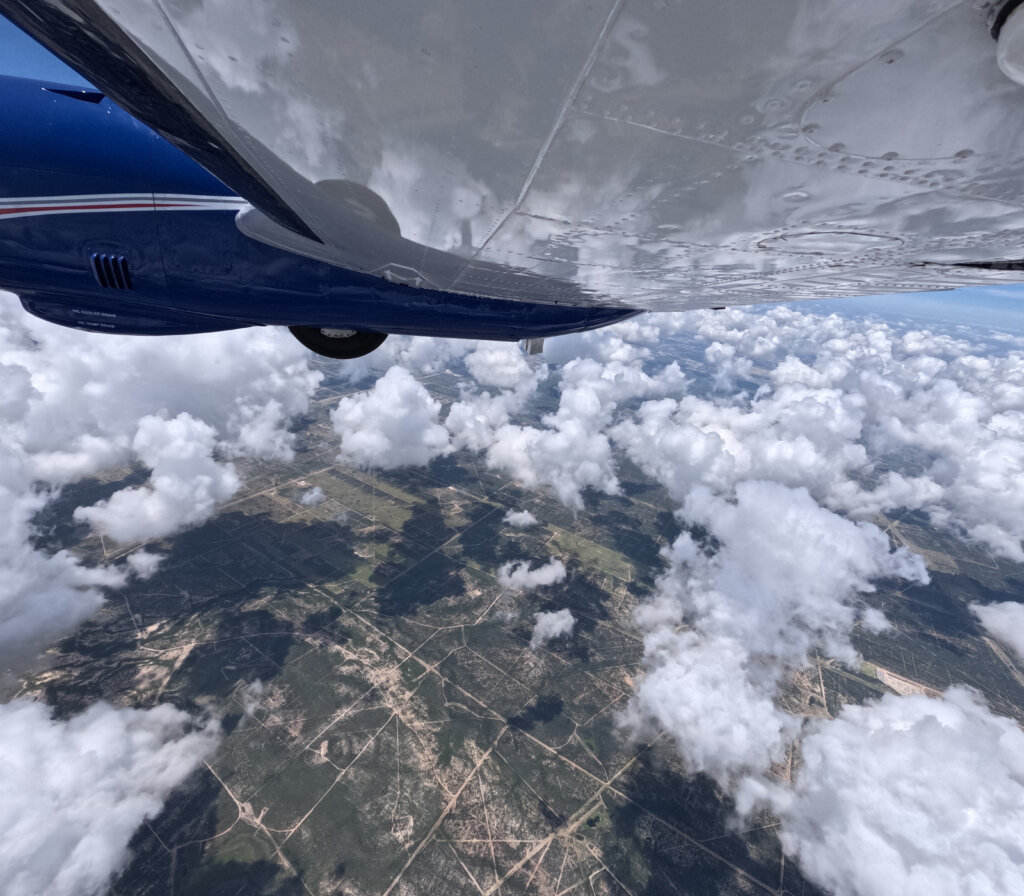
From June 4 through Aug. 17, more than 70,000 wildlife observations were conducted, including 13,000 on the ground, 24,000 by drone and 33,000 by trail camera. Surveillance traps captured tens of thousands of sterile flies and other species, but no wild NWS flies. Meanwhile, 795 million sterile flies had been dispersed across Texas since February 2026 in anticipation of the pest’s arrival.
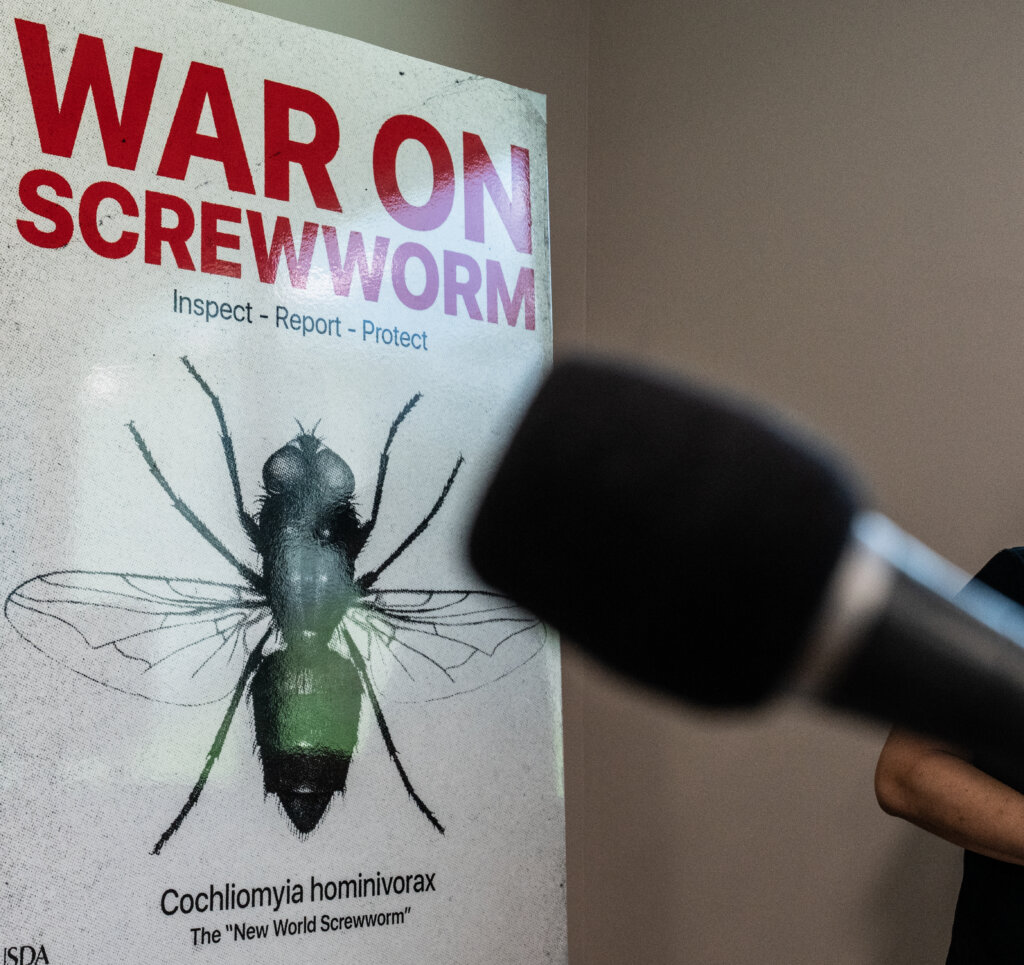
“One of the reasons why this response is as effective as it is right now is because of the producers,” he says. “It is because of TSCRA members standing up and quickly saying, ‘You know what? I think we have a case. We want you to see it.’”
Visual inspection is one of the most effective tools to combat NWS. In cases that are detected and treated early, animals have the strongest likelihood of recovery, and the surrounding infested zone becomes a priority for sterile fly dispersal.
“The best thing you can put on your animals is your eyes,” Schmoyer says, quoting advice from Dr. T.R. Lansford, deputy executive director for Texas Animal Health Commission.
Schmoyer identifies animal movement as one of the primary operational risks involved in containing NWS. From November 2024 through Aug. 17, 2026, Mexico recorded 37,673 infestations, and the vast majority resulted from cattle movement.
“People ask me, ‘How fast can a New World screwworm fly?’” he says. “My usual response is, ‘About 75 miles per hour on an infested animal that is on the back of someone’s truck.’”
One part of the plan for slowing NWS into the U.S. was closing southern ports to live cattle imports from Mexico. While controversial, Schmoyer says the highest-priority question from an operational standpoint was, “What do we need to do to protect the United States?”
The decision required risk calculus, he says, weighing whether the risk of NWS introduction could be reduced to a controlled, manageable level before allowing cattle movement to resume.
On Aug. 24, the Douglas, Arizona, port became the first to reopen to cattle movement from Mexico. Its existing animal health infrastructure, experience managing diseases such as tuberculosis, and distance from known NWS cases across the border made it the first site selected for the phased reopening. Multiple layers of inspection are in place to reduce the risk of an infested animal reaching or crossing the border.
Schmoyer says animals moving through the port will undergo in-depth surveillance, with inspections before they begin moving toward the border, again as they approach, a third time throughout the process and a final inspection as they cross. USDA will assess the reopening daily, looking at adherence to operating procedures and whether any NWS-infested animals reach or are detected at the port.
Livestock also receive insecticide treatment at the checkpoint before being allowed into the U.S. Another new strategy is the use of canines that are trained to detect the scent of NWS larvae and infested wounds.
South of the border, Mexico has been a critical partner in mitigating the spread. “Mexico has been very receptive to all of the feedback we have provided,” Schmoyer says, which includes establishing cattle movement restriction protocols and wildlife surveillance programs, and facilitating sterile fly dispersal through Mexican airspace and transportation systems.
Building capacity
While safely reestablishing cattle movement is the immediate challenge, building enough capacity to push the invasive pest south is the longer-term goal. Historically, 500 million sterile flies per week were required to fully eradicate the pest to the Darién Gap.
The COPEG facility in Panama continues to produce about 100 million sterile flies per week, while the Metapa, Mexico, facility is ramping up toward another 100 million per week. Moore Air Base is expected to initially produce 100 million flies per week after construction is complete, and expand to 300 million per week by late 2028.
With all facilities at full operation, Schmoyer says, the 500 million per week production target will be met.
“What I want to do, and what the secretary has charged me to do, is to push it out of the United States, push it through Mexico, push it down through Central America, back to the Darién Gap where it was previously, and then keep it there,” he says. “The faster we can get more flies, the faster we can do that.”
Along with plans to expand production capacity, a new form of the sterile NWS fly is showing promising signs in the early stages of development.
NovoFly is designed to produce male sterile flies rather than the roughly equal male-female production generated under the conventional process. In past eradication efforts, 500 million sterile flies translated to roughly 250 million sterile males. “In essence, it doubles the operational impact,” Schmoyer says.
Laboratory performance of these flies has been strong. Regulatory approval has been accelerated through coordination with EPA, and field trials are yielding positive preliminary results. Researchers are evaluating the fly’s survivability, longevity and mobility to determine its effectiveness.
Working together
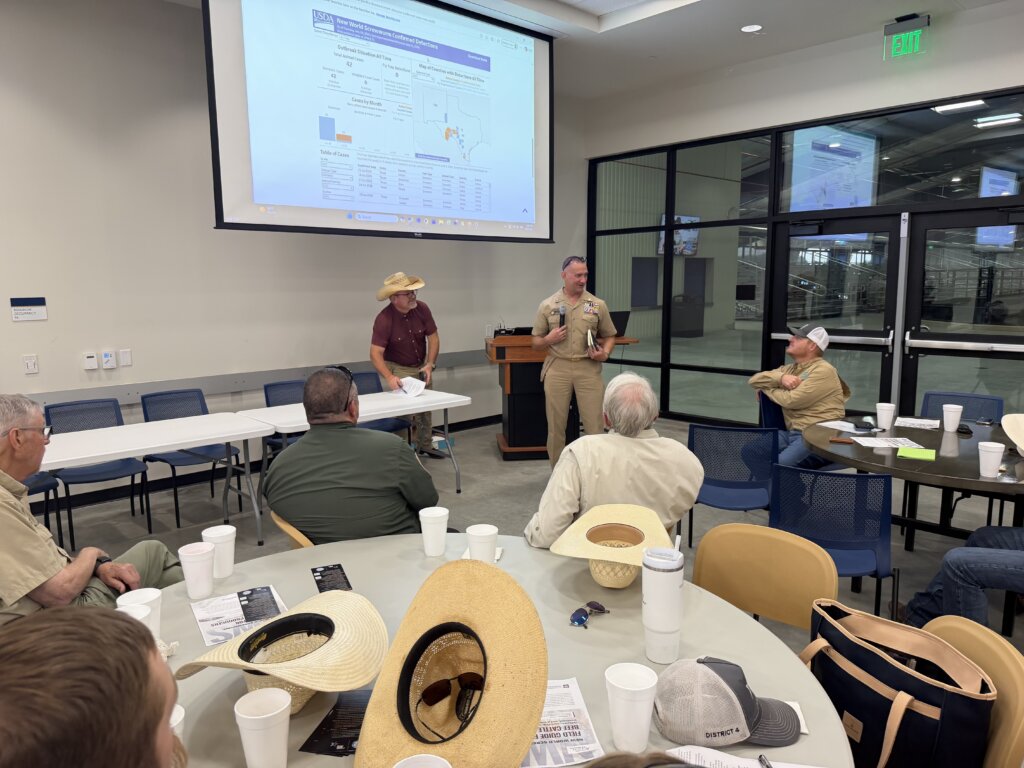
Even with the technology and science behind the NWS response, Schmoyer repeatedly returns to the people making it effective.
After nearly 25 years of battling bugs, working alongside ranchers has been one of the most rewarding parts of his tenure in biological disease control. He credits producers, including Texas & Southwestern Cattle Raisers Association members, for quickly reporting suspected cases and opening their land to surveillance and sterile fly release efforts.
That cooperation has been matched by a distinctly Texan brand of hospitality. When he arrived in Austin without a uniform and in need of appropriate clothes for the string of meetings to follow, Texas Animal Health Commission staff supplied what he needed — all the way down to a borrowed sports coat and cowboy boots.
“A lot of people will give their shirt off their back,” Schmoyer says. “Texans gave me the boots off their feet.”
The experience has left a lasting impression.
“Working with ranchers has been one of the most enriching times of my career,” the rear admiral shares. “Never have I seen a response where everybody is rowing in the same direction. Everybody wants to defeat this.”
Diane Meyer is the associate director of content for Grant Company based in St. Joseph, Missouri.
—-
###