
• Skip to primary navigation
  • Skip to main content
Texas and Southwestern Cattle Raisers Association

Texas and Southwestern Cattle Raisers Association

To Honor and Protect the Ranching Way of Life

  • Home
  • Who We Are
    • Why Join
    • Leadership
    • Staff
    • Partners
    • FAQs
    • Newsroom
    • Sponsorships & Advertisement
    • Employment
  • What We Do
    • Theft and Law
    • Issues & Policy
    • Education
    • Students and Young Professionals
    • The Cattleman Magazine
    • Disaster Relief Fund
    • Cattle Raisers Insurance
    • Cattle Raisers Trading Co
  • Events
    • Cattle Raisers Convention
    • Policy Conference
    • Summer Meeting
    • Ranch Gatherings
    • Ranching 101
  • Join
  • Member Center
  • TSCRA Store
  • Show Search
Hide Search

Anthrax confirmed in Uvalde County

Source: Texas Animal Health Commission | June 21, 2019

The first anthrax case of 2019 was confirmed June 19 in a captive antelope on a premises in Uvalde County.
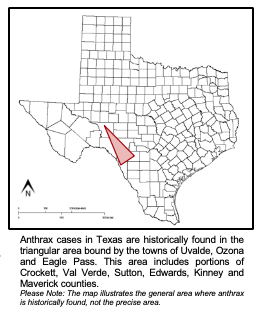
“The premises is located within the triangular area of Texas where anthrax is historically found in the soil,” said Dr. Susan Rollo, state epidemiologist. “There is an effective anthrax vaccine available for use in susceptible livestock in high risk areas. We encourage you to consult with your local veterinary practitioner.”

The premises has been placed under quarantine and the premises will not be released from quarantine until the animals on the premises have been vaccinated and the affected carcasses are properly disposed of, as outlined in TAHC’s rules.

Anthrax is a bacterial disease caused by Bacillus anthracis, which is a naturally occurring organism with worldwide distribution, including certain parts of Texas. The bacteria can surface, contaminating soil and grass after periods of wet, cool weather, followed by hot, dry conditions. During these conditions, animals ingest the anthrax bacteria when they consume contaminated grass and hay, or by inhaling the spores. Outbreaks will usually end when cooler weather arrives.

Acute fever followed by rapid death with bleeding from body openings are common signs of anthrax in livestock. Carcasses may also appear bloated and decompose quickly. Livestock or animals displaying symptoms consistent with anthrax should be reported to a private veterinary practitioner or a TAHC official.

Producers are encouraged to follow basic sanitation precautions when handling affected livestock or carcasses. It is recommended to wear protective gloves, long sleeve shirts and to wash thoroughly afterward to prevent accidental spread of the bacteria to people.

For more information about anthrax, click here to download a handout or see below. You can also contact your local TAHC region office or visit www.tahc.texas.gov.

TAHCBrochure_Anthrax

Written by:
kristin
Published on:
June 24, 2019

Categories: Animal Health, Ranching, The Cattleman Now, The Cattleman Now - App, Wildlife

Recent Posts

Cattle raisers applaud construction contract for Texas based sterile fly production facility

March 9, 2026

FORT WORTH, Texas (March 9, 2026) — Texas & Southwestern Cattle Raisers Association President …

Continue Reading about Cattle raisers applaud construction contract for Texas based sterile fly production facility

Cattle Raisers PAC 2026 primary election results

March 9, 2026

Cattle Raisers PAC, the political action committee for Texas & Southwestern Cattle Raisers …

Continue Reading about Cattle Raisers PAC 2026 primary election results

Crime watch: Cattle stolen in Marion County

March 5, 2026

Texas & Southwestern Cattle Raisers Association Special Ranger Larry Hand, District 13 in East …

Continue Reading about Crime watch: Cattle stolen in Marion County

Footer

Texas and Southwestern Cattle Raisers Association
  • Email
  • Facebook
  • Instagram
  • Twitter
  • YouTube

PO BOX 101988
FORT WORTH, TX 76185

1-800-242-7820

© 2023 Texas & Southwestern Cattle Raisers Association; All Rights Reserved.

COPYRIGHT | PRIVACY POLICY | TERMS OF USE