
Source: ForageFax | March 1, 2019
ForageFax is by the Texas A&M AgriLife Extension Department of Soil & Crop Science, offering timely forage and pasture information.
After a cold, dreary winter we get anxious about our warm season perennial pastures and hay meadows. We start panicking about the winter weeds we see growing, the volunteer ryegrass we see growing and we start making calls to our local fertilizer retailer.
Find more information about dealing with volunteer ryegrass here and dealing with winter weeds here.
Now, let’s take a moment and talk about the RIGHT time to fertilize our warm season pastures/hay meadows.
First and foremost, soil test. If you have not done so for this year, please consider obtaining a soil test now. There is not much that can be done regarding the high cost of fertilizer, but there is much we can do regarding how efficiently we use fertilizer. The soil test is the first step in efficient fertilizer use and improved forage production. Samples should be collected annually for hay meadows and every 2 to 3 years for pastures. For soil test forms and bags contact your County Extension Office or visit http://soiltesting.tamu.edu. You may also wish to read the Testing Your Soil publication that describes how to obtain a soil sample for analysis. The form for submitting soils samples can be obtained by clicking here.
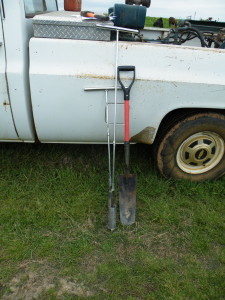
Soil Sampling Tools
Warm season perennial grasses, such as bahiagrass or bermudagrass, green-up when nighttime temperatures remain above 60 degrees F for several days in the spring and soil temperature reaches 65 degrees at the 4-inch depth. For bermudagrass or bahiagrass to utilize any fertilizer, it should be applied after green-up and as active growth begins. Applying any fertilizer prior to this, results in the utilization of nutrients by any volunteer ryegrass and/or any cool season broadleaf weeds (such as thistles, Texas groundsel, henbit, etc.).

Thistle in rosette stage
Usually, the most limiting nutrient in bermudagrass production is nitrogen. Nitrogen is vital to plants for optimum growth. Deficiencies of nitrogen appear as pale green color in the plants, very poor growth and yield and low protein. The optimum nitrogen rate for a situation is dependent upon a producer’s goals. Learn more about nitrogen sources here.
Bermudagrass removes relatively large amounts of phosphate and potash when harvested for hay. Bermudagrass hay removes 14 lbs of phosphate and 42 lbs of potash per ton of hay. Phosphorus is vital in plants for developing a healthy root system and reaching optimum yield. Potassium is essential in plants to combat diseases and aid in water translocation. Deficiencies of potassium can cause both yield losses and stand losses. Bermudagrass can be a luxury consumer of potassium. Meaning, bermudagrass will take in more potassium than it needs if an abundant supply is present. Therefore, if soil test recommendations call for more than 100 lbs of potassium/acre the recommendation is to make split applications throughout the season.
Levels of nitrogen, phosphorus and potassium applied should be based on soil test recommendations as well as match farm/ranch goals.
Be mindful of weather conditions and active growth before you start fertilizing those warm season perennial pastures/hay meadows!
Vanessa Corriher-Olson
Associate Professor, Forage Extension Specialist
Soil & Crop Sciences
Texas A&M AgriLife Extension, Overton,TX
903-834-6191