
Source: ForageFax.tamu.edu | March 8, 2019
Baleage involves baling forage with 50 to 65 percent moisture content, then wrapping the bales in plastic to create an air tight environment. This reduces the weather risk producers commonly face while waiting for the forage to field cure and harvest. Harvesting the forage at higher moisture levels allows for the forage to more readily retain its nutritive value and digestibility compared to conventional hay.
Aerobic (free oxygen requiring) bacteria consume the oxygen remaining inside the hay within a few hours. Under these conditions, anaerobic (non-free oxygen requiring) bacteria reduce the forage pH and preserve the forage. The low pH inhibits mold and respiration losses that typically occur in high-moisture bales. Baleage does not, however, attain as low a pH as silage so it cannot be stored as long. forages baled at 40 to 60% moisture levels will maintain feed value for about 12 months as long as the integrity of the plastic is maintained. While baleage reduces leaf shatter loss and allows you to preserve high-moisture forage, it is typically fed on-farm because it cannot be moved easily (bales are considerably heavier).
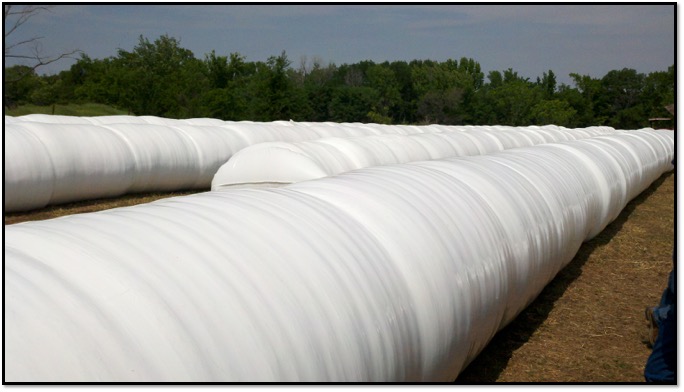
Bales can be wrapped individually or in a row (in-line wrapping). Bales that have been individually wrapped can be moved off site for storage but they must be moved carefully as to not puncture the plastic. A baleage system requires much the same equipment as a conventional hay system, with some additions. The minimum requirements are a mower, maybe a rake, a baler capable of baling wet forage, a tractor of sufficient horsepower to carry heavier bales, a bale spear, and a wrapper. Some custom operators wrap silage, and many local entities may have wrappers available for rent. Baleage becomes more economical with higher-quality forages such as winter annuals (annual ryegrass, small grains), clovers/other legumes mixed with grass, and high quality summer annuals. For East Texas and Central Texas, winter annuals can be challenging to harvest for dry hay during a wet spring. Baleage is an option for harvesting winter annuals during wetter weather.
As you plan for your forage needs, it is important to produce enough forage (hay, stockpiled forage, baleage, etc.) to meet your livestock’s nutrient requirements during periods of limited pasture growth. Forages for harvest (hay or baleage) should be fertilized appropriately and should be harvested at the desired stage of maturity. Plan ahead taking into account weather predictions, forage needs and available resources.
Vanessa Corriher-Olson, Forage Extension Specialist
Soil & Crop Sciences, Overton
Texas A&M AgriLife Extension Service, Texas A&M University System